


Ask ten traders how they decide their position size, and most will admit the honest answer is “a feeling.” Maybe they trade bigger when they’re confident, smaller after a loss, or just default to a round number like 0.10 lots because it’s easy to type. None of those are actual position sizing — they’re guesses dressed up as strategy.
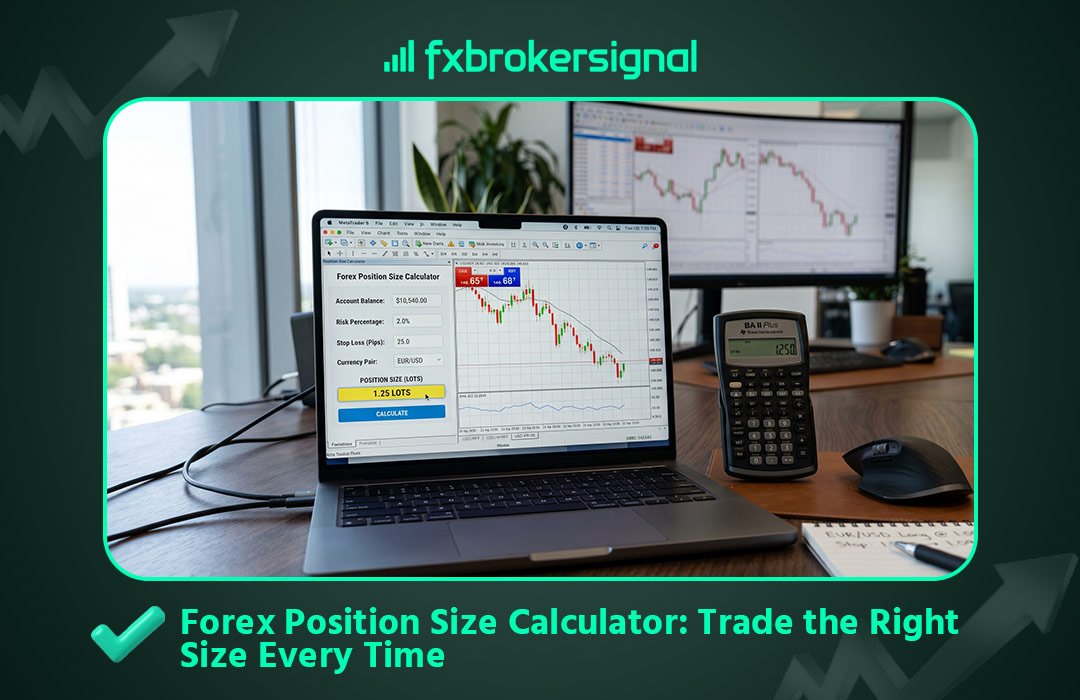
Position sizing is the process of calculating exactly how much of an instrument to buy or sell based on your account size, your risk tolerance, and your stop-loss distance — not your gut feeling. This guide walks through how proper position sizing works and how to do it accurately, every time, using the free Position Size Calculator on FX Broker Signal.
What is position sizing — and how is it different from lot size?
Position size and lot size are closely related but not identical terms. Position size is the broader concept: how much capital, risk, or exposure you’re putting into a single trade. Lot size is the specific unit forex brokers use to express that position size (standard, mini, micro lots).
In practice, when traders say “position size calculator,” they usually mean the same calculation covered in our Forex Lot Size Calculator guide — working backward from your risk tolerance to the exact lot size that keeps your loss within budget if your stop-loss is hit.
The position sizing formula
Position Size = Risk Amount ÷ (Stop-Loss Distance × Value per Pip/Point)
This is the same underlying formula whether you’re trading forex pairs, gold, indices, or other instruments — the value per pip or point simply changes depending on what you’re trading.
Why position sizing matters more than your entry
Here’s a fact that surprises a lot of newer traders: two traders can take the identical signal — same entry, same stop, same take-profit — and one can end the year profitable while the other blows their account, purely because of how they sized their positions.
If Trader A risks 1% per trade and Trader B risks 10% per trade on the same signal, a string of five losing trades (which happens to every trader eventually, even with a sound strategy) costs Trader A about 5% of their account and costs Trader B roughly half their account. Same signals. Same losses. Wildly different outcomes — because of position size alone.
This is why professional risk management frameworks almost universally recommend risking no more than 1–2% of your account per trade, regardless of how confident you feel in the setup.
How to calculate position size step by step
- Decide your risk percentage. Most professional traders use 1% per trade; more conservative traders use 0.5%, and more aggressive traders may go up to 2%. Rarely should this exceed 2% on any single trade.
- Calculate your risk amount in currency. If your account is $8,000 and you’re risking 1%, your risk amount is $80.
- Identify your stop-loss distance. This comes directly from your signal or your own technical analysis — the number of pips (or points, for gold/indices) between your entry and your stop.
- Find the value per pip/point for your specific instrument — see our Pip Value Calculator guide for how this is calculated and why it differs by pair.
- Divide risk amount by (stop-loss distance × value per pip) to get your position size in lots.
Doing all five steps manually for every trade is slow and error-prone — especially under the time pressure of a live signal. That’s exactly the problem our calculator solves.
Use the FX Broker Signal Position Size Calculator
Our Calculator page includes a dedicated Lot Size tab that performs the full position-sizing calculation above in a single step.
To use it:
- Open the Calculator tool and select the Lot Size tab
- Choose your instrument — forex, gold, silver, oil, indices, or crypto
- Select your deposit currency
- Enter your entry level and stop-loss level
- Choose risk tolerance as a percentage or a fixed amount
- Enter your account balance
- Click Calculate Lot Size
The calculator returns your exact position size, plus the dollar amount you’re risking — accounting automatically for the specific pip or point value of whichever instrument you selected.
Position sizing across different instrument types
One of the most common position-sizing mistakes is applying the same formula and assumptions to every instrument. In reality:
- Forex pairs use pip-based stop distances and lot-based contract sizes (100,000 units per standard lot)
- Gold (XAUUSD) uses a different contract size and price-per-point structure entirely — see our dedicated XAUUSD lot size calculator guide
- Indices (like US30, US100) are sized in points rather than pips, with their own contract specifications
- Crypto pairs often have far higher volatility, meaning the same percentage risk can require a meaningfully smaller position size
Our calculator handles all of these instrument types from a single interface, so you’re not relying on memorized formulas that may not apply to what you’re actually trading.
Position sizing for signal-based trading
If you trade based on signals — like the ones published daily in our Live Signals feed — position sizing becomes even more important, because the entry and stop-loss are already defined for you. Your only remaining job is to size the trade correctly for your account.
Here’s the typical workflow:
- A signal posts with a fixed entry and stop-loss
- You open the Position Size / Lot Size Calculator, enter your account balance and chosen risk %
- Input the entry and stop-loss exactly as given in the signal
- Get your exact lot size in seconds and place the trade
If you use Telegram Trade Linker (TTL), you can pre-set your risk parameters once, and the copier will size each incoming signal automatically on your MT4/MT5 account — removing manual calculation from the process entirely.
Common position sizing mistakes
Using the same lot size for every trade regardless of stop distance. A tighter stop with the same lot size means lower dollar risk; a wider stop means higher risk. Position size should adjust to keep risk consistent, not lot size.
Sizing up after losses to “win it back.” This is one of the fastest ways to turn a manageable drawdown into an account-ending one. Risk percentage should stay constant regardless of recent results.
Not accounting for correlated positions. If you’re holding multiple trades on correlated pairs (e.g. EUR/USD and GBP/USD simultaneously), your true combined risk exposure is higher than any single trade’s calculation suggests.
Final thoughts
Position sizing is the difference between trading with a system and trading on instinct. The good news is that you don’t need to be a math expert to get it right — you need a consistent risk percentage and a reliable calculator.
Use the free Position Size Calculator on FX Broker Signal before every trade, follow structured entries from our Live Signals page, and let the numbers — not the feeling — decide how big each trade should be.

