


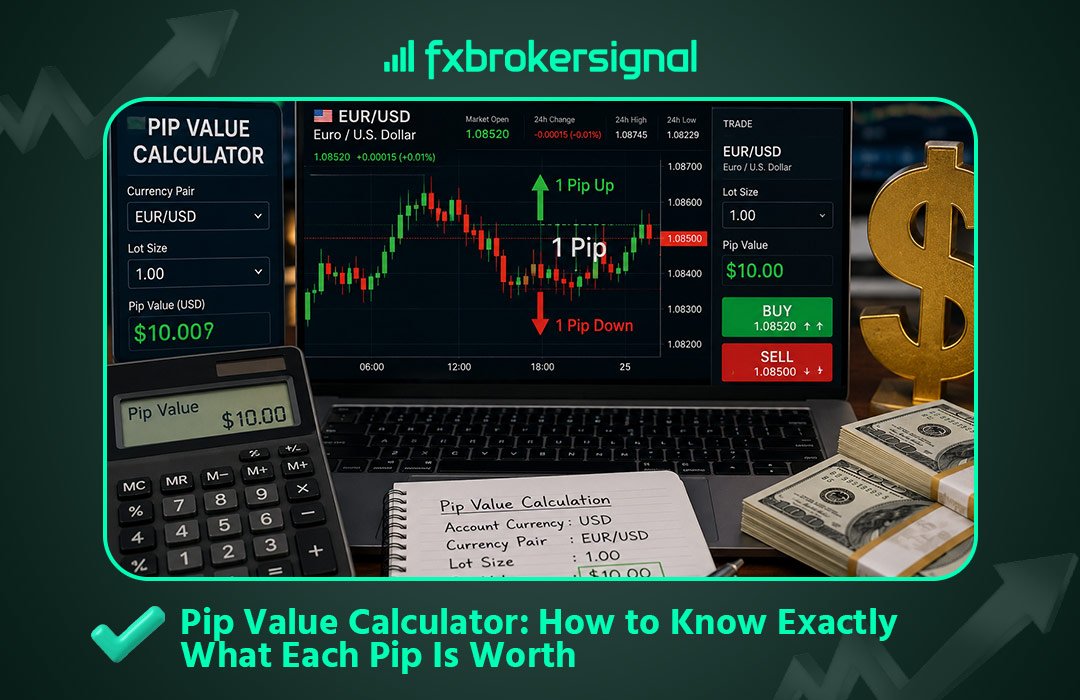
If you’ve ever looked at a trade that moved “30 pips in your favor” and had no idea what that actually meant in dollars, you’re not alone. Pips are the language traders use to talk about price movement — but pips alone don’t tell you your profit or loss. Pip value does.
Understanding pip value isn’t optional if you’re trading with real money. It’s the bridge between “the market moved” and “here’s what that movement actually cost or earned you.” In this guide, we’ll break down exactly what a pip is, how pip value is calculated, why it changes between currency pairs, and how to get an instant, accurate answer using the free Pip Value Calculator on FX Broker Signal.
What is a pip?
A pip (percentage in point) is the smallest standard price movement a currency pair makes. For most forex pairs, a pip is the fourth decimal place:
- EUR/USD moving from 1.0850 to 1.0851 = 1 pip
- For JPY pairs, a pip is the second decimal place, since JPY pairs are quoted differently (e.g. USD/JPY moving from 148.20 to 148.21 = 1 pip)
Some brokers also quote in fractional pips (a fifth decimal place), often called “pipettes,” for more precision.
What is pip value?
Pip value is how much money one pip of movement is worth, given your position size and the currency pair you’re trading. It’s the number that turns “the market moved 25 pips” into “I made $250” or “I lost $250.”
The formula looks like this:
Pip Value = (Pip Size ÷ Exchange Rate) × Lot Size (in units)
This sounds simple, but the actual number changes depending on three things:
- The currency pair — because pip size and quote conventions differ between pairs
- Your lot size — a standard lot, mini lot, or micro lot will all produce different pip values for the same price movement
- Your account currency — if your account currency isn’t the same as the pair’s quote currency, an exchange rate conversion is needed
Worked example
Let’s say you’re trading 1 standard lot (100,000 units) of EUR/USD, and your account is funded in USD.
Since EUR/USD is quoted to four decimal places and USD is the quote currency, each pip movement equals:
0.0001 × 100,000 = $10 per pip
So if the price moves 30 pips in your favor, your profit is:
30 pips × $10 = $300
Simple enough for EUR/USD with a USD account. But change the pair to GBP/JPY, or change your account currency to EUR, and that $10-per-pip figure no longer applies — the calculation has to account for the JPY pip convention or a currency conversion, and doing this by hand for every trade is where mistakes creep in.
Why pip value differs between currency pairs
This is the part that trips up most beginner traders. Pip value is not a fixed number across all pairs — it depends on which currency is the quote currency in the pair you’re trading.
- USD as quote currency (e.g. EUR/USD, GBP/USD): pip value on a standard lot is a clean $10 (assuming a USD account)
- JPY pairs (e.g. USD/JPY, EUR/JPY): pip value is calculated differently because of the different decimal convention, and will vary based on the current exchange rate
- Cross pairs (e.g. EUR/GBP, AUD/NZD): pip value requires converting through the quote currency’s exchange rate
- Gold (XAU/USD): pip value works completely differently again, since gold is priced and sized differently from currency pairs — see our dedicated guide on the XAUUSD lot size calculator for the gold-specific breakdown
This is exactly why relying on a single memorized “$10 per pip” rule across every pair on your watchlist is a fast way to miscalculate your real risk and reward.
Use the FX Broker Signal Pip Value Calculator
Rather than recalculating this by hand for every pair, every trade, the Calculator page on FX Broker Signal has a dedicated Pip Value tab built for exactly this.
Here’s how to use it:
- Visit the Calculator tool and select the Pip Value tab
- Choose your instrument from the dropdown — forex pairs, gold, silver, oil, and indices are all supported
- Select your deposit/account currency
- Enter your lot size
- Enter the number of pips you want to calculate for
- Click Calculate Pip Value
You’ll get an instant, accurate pip value figure that automatically accounts for the pair’s quote convention and any currency conversion needed — no manual lookup tables required.
Why pip value matters for every signal you take
Pip value is the missing link between a signal’s stop-loss distance and what that stop-loss actually costs you in dollars. When you see a signal in our Live Signals feed with, say, a 35-pip stop loss, that number is meaningless to your risk management until you know what each of those 35 pips is worth on your position size.
This is also exactly why pip value and lot size work together, not separately. Once you know the pip value for your pair, you can plug it directly into the lot size formula to find your exact position size for a given dollar risk — see our Forex Lot Size Calculator guide for the full walkthrough.
Common pip value mistakes to avoid
Assuming $10/pip across every pair. This only holds for standard lots on USD-quoted pairs with a USD account. JPY pairs, cross pairs, and metals all behave differently.
Forgetting account currency conversion. Traders funding accounts in GBP, EUR, or other non-USD currencies often skip this step and end up with risk calculations that are meaningfully off.
Mixing up pip value with profit/loss. Pip value is per pip. To get total profit or loss, you still need to multiply by the number of pips the trade actually moved — our Forex Profit Calculator guide walks through that next step.
Frequently asked questions
Is pip value the same on every broker? Largely yes for standard forex pairs, since pip conventions are an industry standard. However, contract sizes for non-forex instruments like gold and indices can vary by broker, which is why it’s worth confirming your broker’s specification or using a calculator that lets you select your exact instrument.
Does pip value change as the market moves? For pairs where your account currency differs from the quote currency, yes — pip value will shift slightly as the underlying exchange rate moves, since a currency conversion is part of the calculation. For pairs where your account currency matches the quote currency, pip value stays constant regardless of price movement.
Why do JPY pairs have different pip values than other pairs? JPY pairs are quoted to two decimal places instead of four, because of how the yen’s value compares to other major currencies. This changes both what counts as “one pip” and the resulting pip value calculation — another reason a dedicated calculator is more reliable than a single memorized rule.
Final thoughts
Pip value is one of those concepts that seems abstract until you actually need it mid-trade — and then it becomes the most important number on your screen. Rather than memorizing approximate values or doing manual conversions under time pressure, use the free Pip Value Calculator on FX Broker Signal to get an exact figure in seconds, for any pair, any lot size, any account currency.
Pair it with our Live Signals and you’ll always know exactly what’s at stake before you click “buy” or “sell.”

